


Fortress of Chiusaforte



The main route connecting the Friulian plain with Austria is the Val Fella, a long valley stretching from Venzone to Pontebba.
Here visitors can explore Chiusaforte, a village that already in the Middle Ages served as a customs post for the Patriarchate of Aquileia. Its strategic role as a border and control point was further strengthened during the 20th century with the construction of a military fortress.
Built in 1904 and made operational shortly afterwards, the fort can be reached by passing through the village of Moggio Udinese and turning left just before arriving in Chiusaforte, near the Ponte Peraria railway tunnel. From there, the road climbs up Col Badin, where the fortress stands and where visitors can also enjoy stunning views over the nearby Julian Alps.
The structure has four floors, including the armoured battery level, and from the outside it resembles a residential building more than a military installation thanks to its many balconies. Beyond the iron gate, visitors can still see several areas such as the casemates, the kitchen, storage rooms, officers’ quarters, troop accommodation, as well as a workshop and a power station. Access is also possible to what once served as the ammunition depot, easily recognisable by the inscription above the entrance.
A steep staircase inside leads to the artillery positions, each flanked by a small room used for the immediate supply of ammunition. The planned armament consisted of four 120 mm cast-iron cannons mounted on armoured turrets capable of rotating 360°, although the concrete structure proved relatively weak.
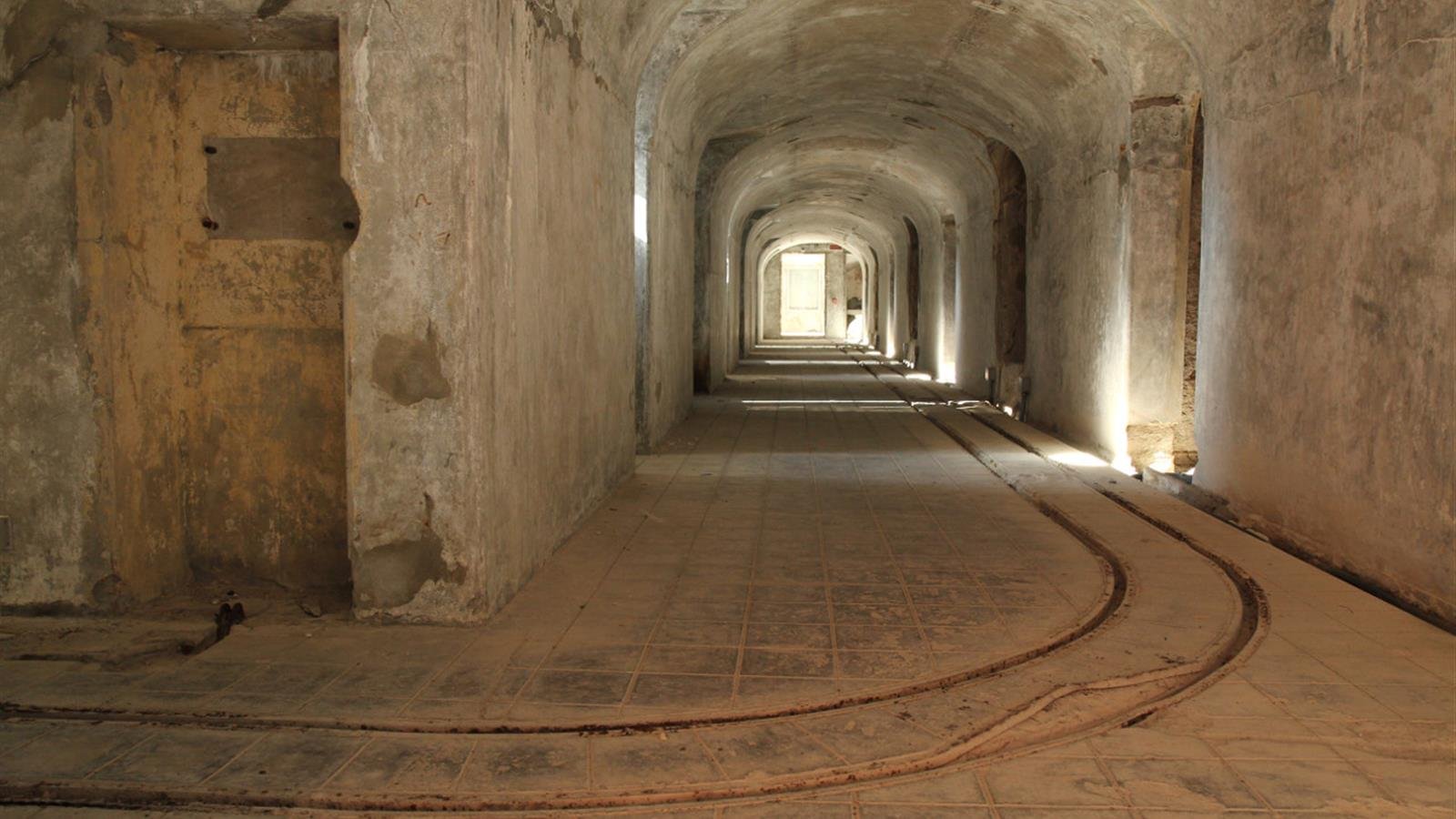
Back in the main courtyard, along a walkway, visitors reach the underground powder magazine equipped with a freight lift, while storage rooms are located behind it. On the square, the rails once used by the ammunition carts transporting shells from the powder magazine to the armoured battery are still clearly visible.
During the war, the Chiusaforte Fortress was never decommissioned and managed to slow down the Austro-German advance after the Retreat of Caporetto. On 29 October 1917, Italian soldiers engaged in a violent clash with the 30th Feldjäger Battalion, but after only a few hours they were captured, leaving the road south completely open.

Information
Temporary closed
How to get there
Take the A23 motorway and exit at Carnia/Tolmezzo, then continue towards Chiusaforte/Tarvisio along the SS13 state road. Once in the municipality of Chiusaforte, the parking area can be found near kilometre marker 182 VIII on the SS13. From there, continue on foot along the path leading to the fortress.