


Redipuglia Military Memorial



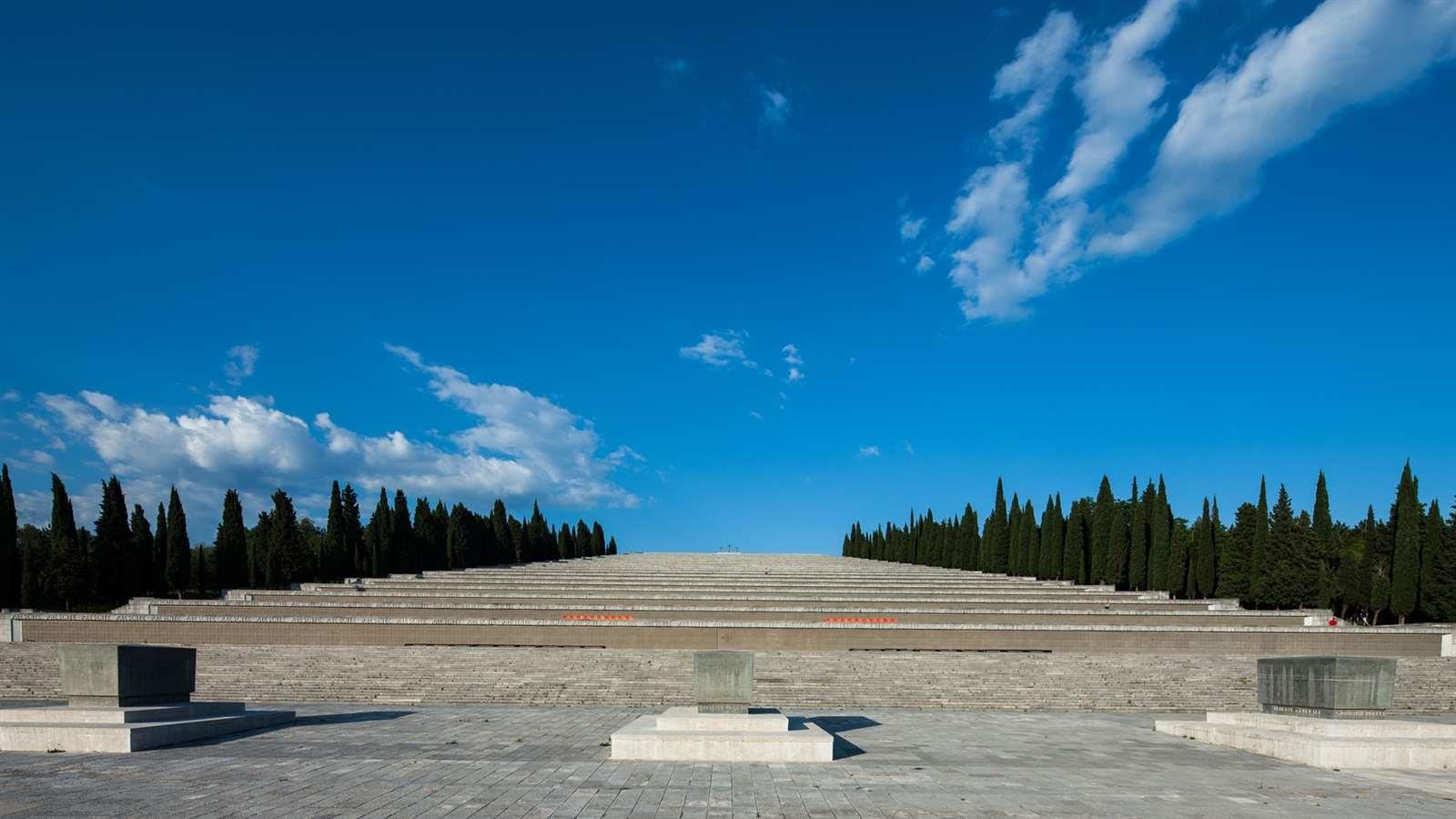
The Redipuglia Shrine is the largest and most imposing Italian shrine dedicated to those who fell in the Great War. Built on the slopes of Monte Sei Busi to a design by architect Giovanni Greppi and sculptor Giannino Castiglioni, it was inaugurated on 18 September 1938 after just under three years of work. Also known as the Shrine of the “Hundred Thousand”, it contains the remains of 100,187 soldiers who fell in the lower Isonzo area, some of whom had initially been buried on the facing hill of Sant’Elia.
Strongly desired by the Fascist regime, the shrine was meant both to celebrate the sacrifice of the fallen and to provide a dignified and final burial place for those who had found no room in the Cemetery of the Unvanquished. The structure is composed of three levels and symbolically represents an army descending from heaven, led by its commander, along the Via Eroica. At the top, three crosses evoke Mount Golgotha and the crucifixion of Christ.
After parking in the large car park beyond the Dottori canal, visitors enter the shrine by passing the chain of the destroyer Triglav, an Austro-Hungarian ship that became Italian after the war and was renamed Grado. Approaching the steps, one follows the Via Eroica, a stone-paved road lined with 38 bronze plaques bearing the names of the Karst localities contested during the Great War.
At the end of this evocative path stand the majestic tombs of the generals, among which the most prominent is that of Emanuele Filiberto, Duke of Aosta and commander of the Third Army, who had wished to be buried among his soldiers. His tomb is a block of red marble from Val Camonica weighing 75 tons. Beside it are the granite tombs of five generals: Antonio Chinotto, Tommaso Monti, Giovanni Prelli, Giuseppe Paolini and Fulvio Riccieri.
Behind them rise the 22 great steps, 2.5 metres high and 12 metres wide, which in alphabetical order contain the remains of the 39,857 identified soldiers. Each loculus is surmounted by the word “Presente”, and the steps can be reached by the side staircases leading to the top. At the centre of the first step lies the only woman buried here, the nurse Margherita Kaiser Parodi Orlando, decorated with the Bronze Medal for Military Valour, while on the twenty-second are the remains of 72 sailors and 56 men of the Guardia di Finanza.
At the top of the shrine, two huge bronze slabs mark the two great graves containing the remains of more than 60,000 unknown soldiers. Between them stands the chapel housing the “Deposition” and the Stations of the Cross panels by Castiglioni. Above it stand the three bronze crosses.
Behind the last step, two small museum rooms have been arranged, containing photographs relating to the cemetery of Sant’Elia hill, documents, war relics and the paintings by Giuseppe Ciotti that decorated the first tomb of the Duke of Aosta, originally placed in the little chapel at the top of Sant’Elia. On the plateau, at Hill 89, there is an observation point and a model of the territory showing the front lines during the campaigns fought between 1915 and 1917.

Information
Via III Armata
I-34070 Fogliano Redipuglia (GO)
0039 0481 489024
redipuglia@onorcaduti.difesa.it