


Ungaretti Park of Sagrado


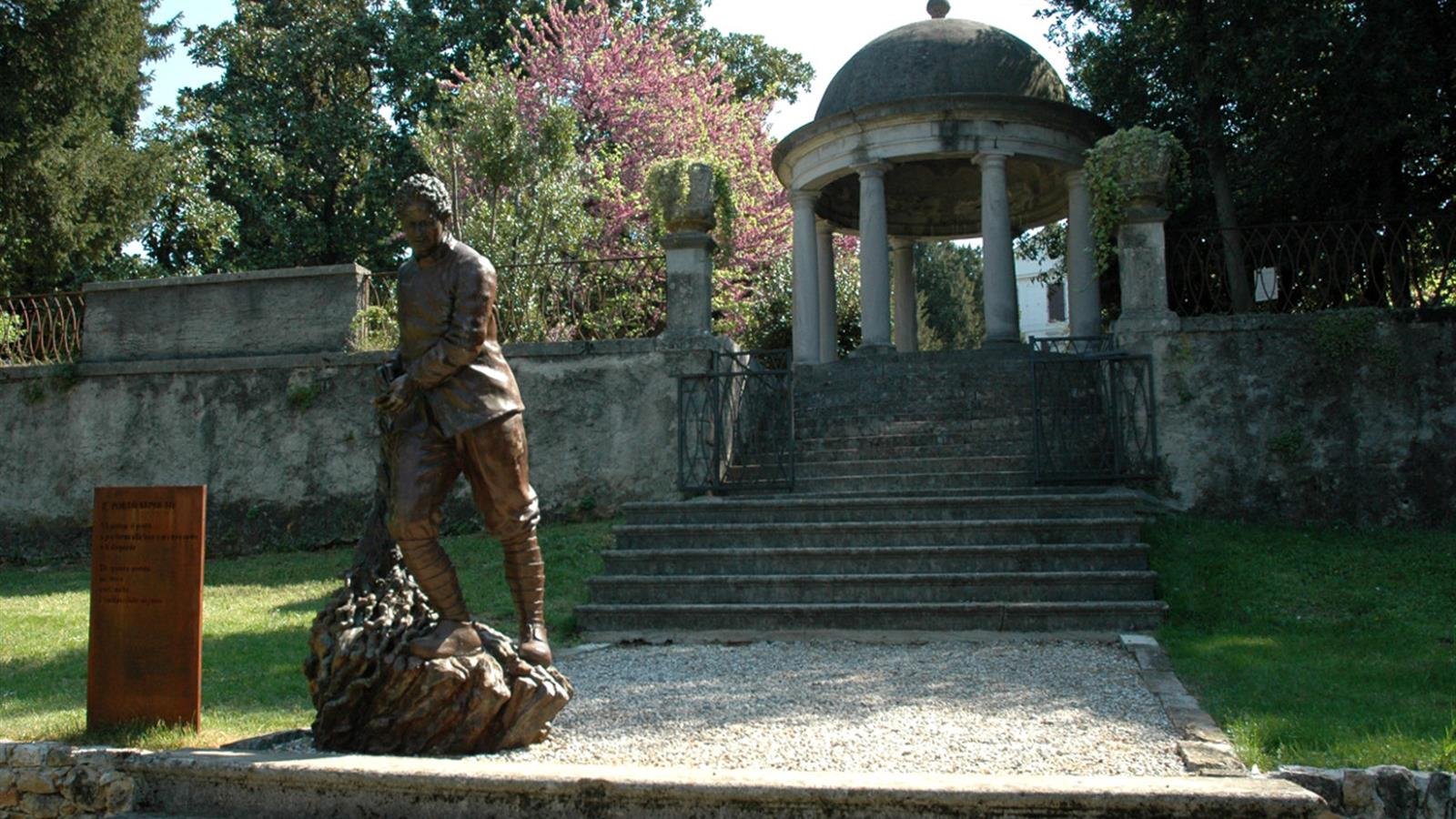
The area of San Martino del Carso, in the municipality of Sagrado, scene of some of the fiercest fighting of the Great War, was one of the places where Giuseppe Ungaretti served and from which he drew inspiration for his first poetry collection, *Il porto sepolto*, first published in 1916.
A central figure in twentieth-century Italian literary and cultural history, Ungaretti’s experience on the Karst is today also commemorated through the park that bears his name.
The site is located in Castelnuovo, beside a villa surrounded by vineyards planted where trenches once ran. For a period, the villa itself served as an Italian military headquarters, as demonstrated by soldiers’ graffiti recently brought back to light.
The Ungaretti Park, owned by the Castelvecchio agricultural estate, was restored according to a design by the architect Paolo Bornello. Its purpose is to guide visitors in discovering the relationship between the Karst landscape, the Great War, and the poetry of Giuseppe Ungaretti.
The park is organised into three principal areas. The first is the Tower, set against the old retaining wall of the garden and formed by a structural frame of rough tree trunks ten metres high supporting a cubic corten-steel structure.
Two of its sides are made of glass engraved with Ungaretti’s poems.The second area is the Sacred Enclosure, a small mound where ten blocks of Karst stone surround a weathered corten-steel stele. Both the stones and the stele bear engravings of Ungaretti’s verses.
Finally, there is the Shrine, a labyrinth composed of rough wooden poles 6.10 metres high arranged on a six-by-six-metre grid, compelling visitors to move through the space without any prescribed direction. At its centre lies a brass plaque bearing a portrait of Ungaretti in old age by Franco Dugo, supported by two poles engraved with the poet’s writings.

Infos
c/o Azienda Agricola Castelvecchio
via Castelnuovo, 2
I-34078 Sagrado (GO)
Associazione Amici di Castelnuovo
Via Castelnuovo, 2
I-34078 Sagrado (GO)
0039 0481 99742
info@amicidicastelnuovo.it