


Victory Lighthouse of Trieste


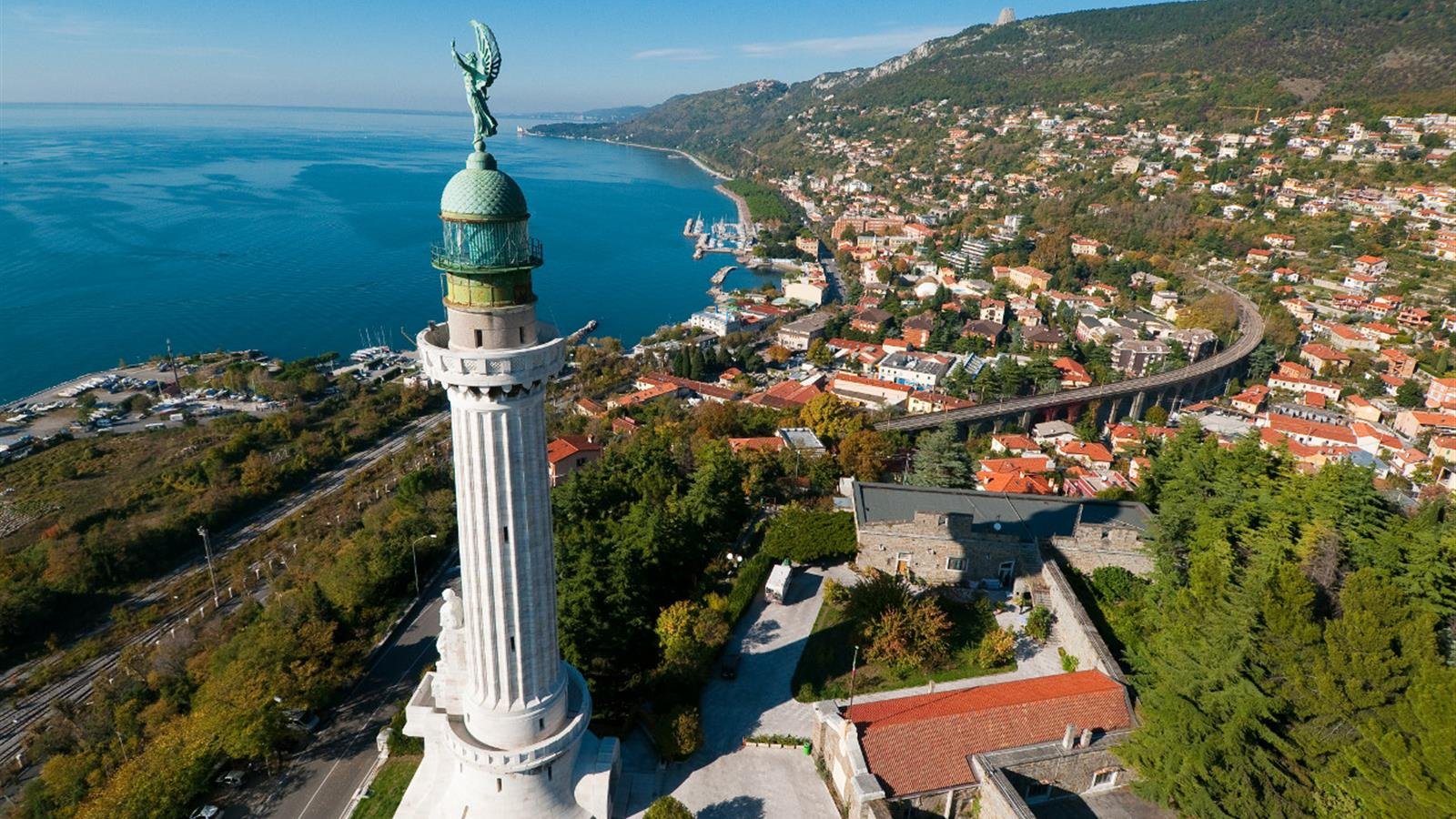
Along the scenic Strada del Friuli, which leads from the city centre towards the hamlet of Prosecco, visitors can stop and admire the Victory Lighthouse.
Designed in the early post-war years by the Trieste architect Arduino Berlam and sculptor Giovanni Mayer, it had a dual purpose: to light the Gulf of Trieste and to celebrate the city’s passage to the Kingdom of Italy.
The lighthouse was built on the bastion of the former Fort Kressich, erected in 1854 to watch over the Gulf of Trieste to a design by Karl Möring. The fort is very well preserved, although today only the parts shared with the lighthouse can be visited.
Construction began in 1923 and lasted four years. It was finally inaugurated in the presence of King Victor Emmanuel III on 24 May 1927, anniversary of the Kingdom of Italy’s entry into the war.
About 70 metres high, the lighthouse consists of a base, a great fluted column and the lantern that lights the gulf and is visible from 22 miles away. The complex is crowned by a 7-metre statue of Winged Victory, whose wings were designed to move with the wind. The base is enriched by the statue of a sailor and by the anchor of the destroyer Audace, the first ship to arrive in Trieste on 3 November 1918. It also bears the inscription attributed to D’Annunzio, “Shine and remember those fallen at sea”.
The area is delimited by an anchor chain from the SMS Viribus Unitis, flagship of the former Austrian fleet, handed by Emperor Charles to the National Committee of Slovenes, Croats and Serbs and sunk at Pula by Italian raiders on 1 November 1918.

Information
Strada del Friuli, 114
I-34136 Trieste
0039 040 3774783
farodellavittoria@regione.fvg.it
For information on opening hours and visiting arrangements, please visit the website