


Colle Sant’Elia of Redipuglia



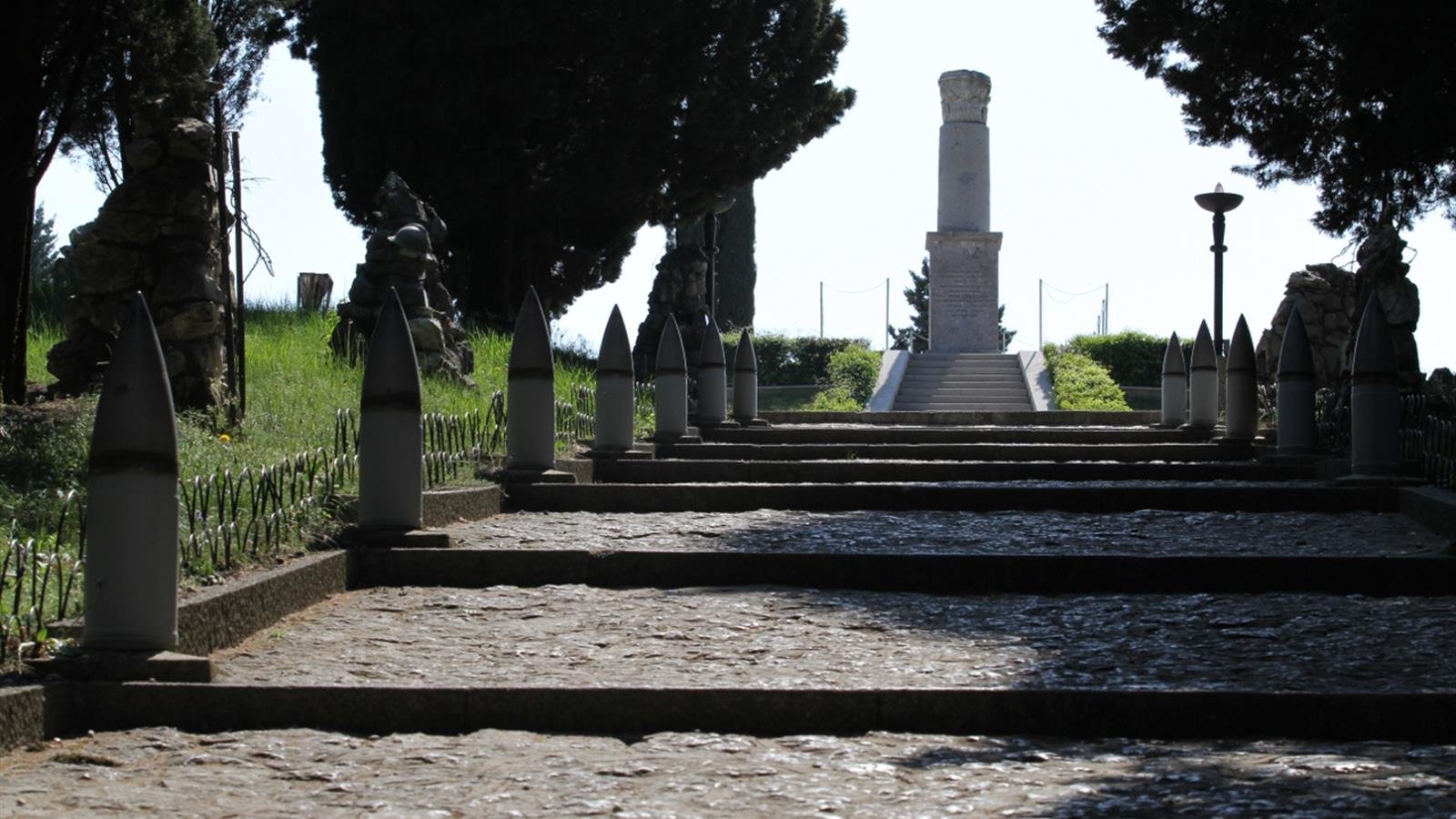
Colle Sant’Elia is a hill located opposite the Redipuglia Shrine which once housed the Cemetery of the Unvanquished of the Third Army, the first monumental Italian memorial of the Great War.
Created from 1920 onwards by the Central Office for the Care and Honours of the Fallen, the site was inaugurated in 1923 and contained the remains of 30,000 soldiers who had fallen in the surrounding area, as well as, from 1931, the body of Emanuele Filiberto, Duke of Aosta and commander of the Third Army during the conflict.
The concept behind the shrine was to recreate the battlefield itself, considered the only true way to commemorate those who had fallen on the Karst. For this reason, the hill was reshaped using large quantities of explosives in order to create seven concentric terraces along which the burials were arranged. At the summit, a large square was built with a votive chapel containing the cycle of paintings by Giuseppe Ciotti depicting the lives of the soldiers, and a lighthouse-shaped obelisk marking the end of the long avenues crossing the cemetery. From the hill, visitors could clearly see the front line across the Isonzo Karst and Mount Sei Busi, the scene of the first six Battles of the Isonzo.
The burials were organised into sectors corresponding to the original locations from which the remains had been exhumed among the countless war cemeteries scattered along the front. They were marked by objects created from war debris recovered on the battlefields and reworked by soldiers. These funerary elements were accompanied by inscriptions composed by the playwright and war volunteer Giannino Antona Traversi.
Over the following years, many of these artefacts deteriorated because of exposure to the elements. Restoration work ceased in 1936, when the Fascist regime commissioned the construction of the Redipuglia Shrine, intended as a monumental memorial celebrating those who had fallen in the Great War. With the inauguration of the shrine in 1938, the Cemetery of the Unvanquished lost its function and the remains of the 30,000 soldiers were transferred to the new memorial.
At the end of the Second World War, Colle Sant’Elia was transformed into a Memorial Park based on a design by Paolo Caccia Dominioni, a soldier and artist closely associated with the Karst region. Today, it consists of a broad terraced avenue displaying reproductions of the original relics and inscriptions. At its summit there is no longer the former chapel and obelisk of faith, but instead a Roman column from Aquileia, placed there in 1964 to commemorate combatants from all branches of the armed forces.

Information
Via III Armata (in front of the Redipuglia Memorial)
I-34070 Fogliano Redipuglia (GO)
0039 0481 489024